People
Protect health and functional capacity.
Understand exposure, physiological strain, individual susceptibility, acclimatisation, fatigue, hydration, recovery and workforce vulnerability.
MMS 911 EMS helps mining and high-risk operations identify, quantify and manage thermal risk before it compromises people, compliance or operational performance.
Left inadequately controlled, increasing thermal exposure can affect employee health and functional capacity, contribute to fatigue and medical events, increase pressure on emergency-response systems, create regulatory and compliance exposure and ultimately affect the ability of an operation to work safely and effectively.
MMS 911 EMS approaches thermal stress as an integrated health, risk and operational challenge—not simply an environmental measurement or hydration issue.
Understand exposure, physiological strain, individual susceptibility, acclimatisation, fatigue, hydration, recovery and workforce vulnerability.
Identify regulatory and system gaps, strengthen thermal-risk management programmes and support demonstrable implementation of appropriate controls.
Understand how thermal exposure interacts with workforce capacity, work practices, emergency risk and operational continuity.
Thermal risk reaches across environmental exposure, human physiology, occupational health, operational controls, emergency preparedness and regulatory systems.
Managing these elements in isolation can leave important gaps. MMS 911 EMS brings them together into one coordinated view of the operation.
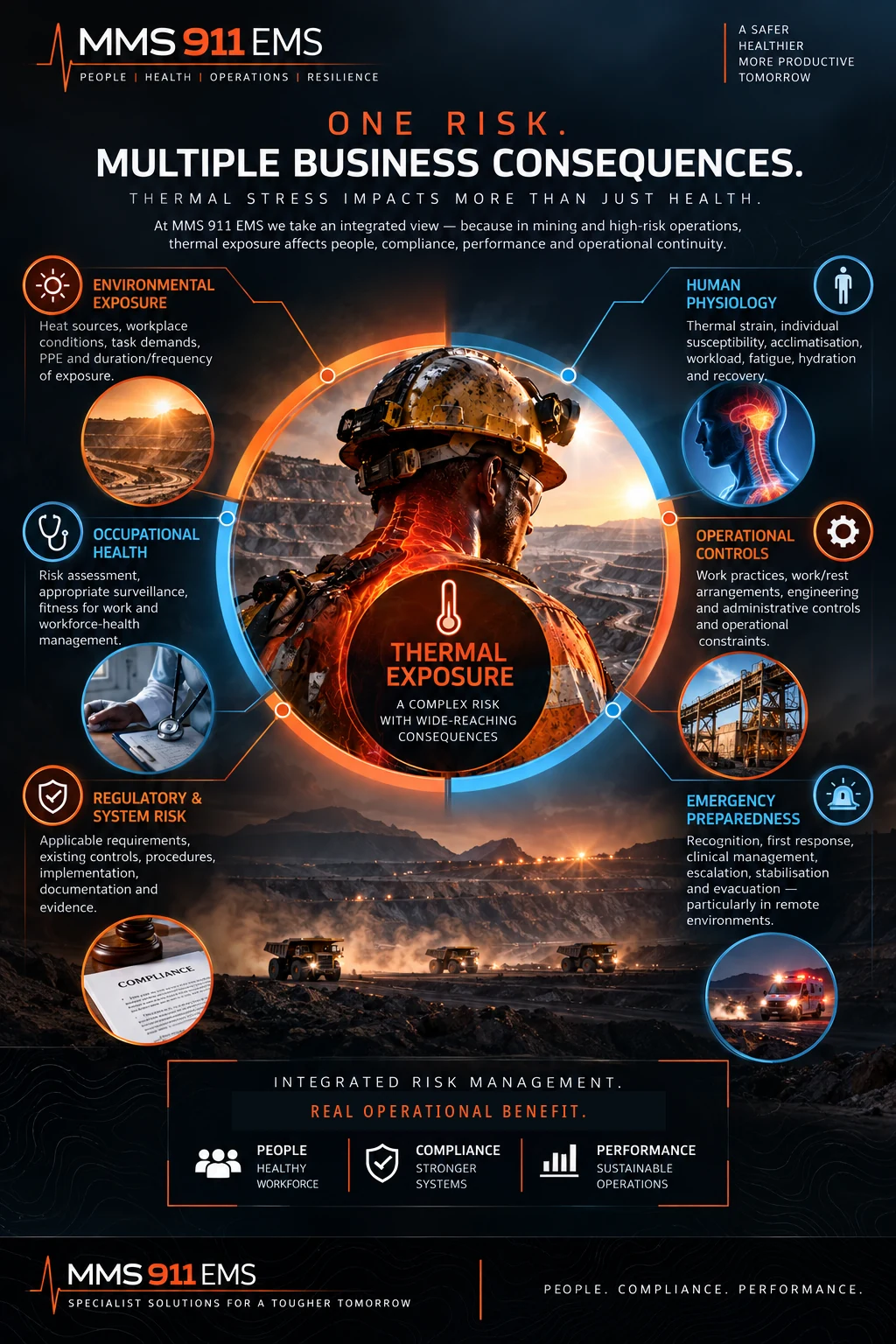
Effective thermal-risk management requires different disciplines to work together. MMS 911 EMS integrates occupational health, occupational hygiene, medical surveillance, workforce health, emergency preparedness, risk management and operational controls into a coordinated approach appropriate to the realities of each operation.
Establish the current thermal-risk environment, exposed work groups, tasks, existing controls, workforce factors and operational vulnerabilities.
Review existing thermal-stress systems against applicable requirements and recognised good practice to identify gaps and priorities.
Translate technical findings into clear management priorities: what requires attention, why it matters and where intervention should begin.
Develop an integrated control strategy appropriate to the mine, workforce, environment and operational realities.
Support practical implementation across procedures, controls, workforce education, health interventions and management systems.
Incorporate severe heat illness into recognition, response, stabilisation, escalation and evacuation systems.
Establish meaningful indicators to evaluate whether controls are functioning and where adjustment is required.
Provide continuing review and specialist input as conditions, operations, workforce characteristics and requirements evolve.
Mining combines environmental exposure, physical workload, PPE, workforce variability, production requirements and—in many operations—distance from definitive medical care.
Underground, surface and remote mining environments therefore require thermal-risk solutions that work not only on paper, but within the realities of the operation.
Severe heat illness can become a time-critical medical emergency. In remote and industrial environments, outcomes may depend not only on recognising the condition, but on what happens between first presentation and definitive care.
MMS 911 EMS incorporates emergency preparedness into thermal-risk management—from early recognition and onsite response to clinical escalation, stabilisation and evacuation planning.
Explore Medical & Emergency Services →Complex occupational risks rarely belong to one discipline. MMS 911 EMS brings together complementary expertise across occupational and clinical medicine, workforce health, emergency medical management, risk and operational environments to develop solutions that consider both the employee and the business.
Meet our team →Understand your current exposure, controls, regulatory position and operational vulnerabilities before thermal risk becomes an avoidable constraint on your people or your operation.
Assess your operation →Speak to MMS 911 EMSManaging heat stress in the workplace requires an assessment of the environment, the job and the people doing it. Underground mines, surface operations, processing plants and remote workplaces can have different exposure patterns; their controls and response plans need to reflect those differences.
A review considers heat exposure, physical workload, clothing and PPE, shift patterns, existing controls and workforce factors. These findings inform priorities for engineering measures, work organisation, recovery opportunities, acclimatisation, training, health oversight and emergency readiness. Hydration is one part of this programme.
MMS brings these elements into the thermal-risk assessment, gap analysis, management strategy and implementation support described above. The agreed scope should identify what needs attention, who is responsible and how the operation will monitor progress.
It should identify exposed jobs and work groups, assess relevant environmental and workload factors, define practical controls, support acclimatisation and training, and establish monitoring and emergency arrangements. The detail depends on the operation and its applicable requirements.
Water access is important, but a heat management programme also considers engineering and work-practice controls, workload, recovery, acclimatisation, PPE and emergency procedures. NIOSH workplace guidance describes this combination of controls.
Gradual adaptation to work in heat is an important part of managing exposure. New workers and people returning after time away may need particular attention. The approach should reflect the job, conditions and individual circumstances rather than a universal schedule.
Occupational health helps consider individual susceptibility, medical surveillance and fitness for the work involved. Heat management also needs input from workplace risk, hygiene and operations. Explore our occupational health services.
Share your site location, workforce size, work environment, shifts, known heat exposure concerns and existing heat management arrangements. MMS will discuss the assessment scope, available information and priorities for your operation.
Discuss your workplace heat risks →
Further guidance: NIOSH workplace heat recommendations and acclimatisation guidance. These resources inform good practice; each site requires its own assessment.